

Buying a used car from Japan can be one of the smartest ways to get a clean, well-maintained vehicle in Cyprus. Japanese cars are popular for a reason: good equipment, strong reliability, detailed auction history and often better condition than many used cars already on the local market.
But there is one document that should never be ignored before buying.
The Japanese auction sheet.
For many buyers, it looks like a small piece of paper full of numbers, letters, Japanese comments and strange marks around a car diagram. In reality, this document can tell you whether the car is a good opportunity — or a very expensive mistake.
At Cyprus Auto Service, we always say one thing clearly: a car should not be judged only by photos. Photos can look perfect. The auction sheet often tells the real story.
If you are planning to buy directly from Japanese auctions, you can also view available auction and stock cars through our trusted partner platform:
Buy Car in Cyprus — Japanese auction and stock cars.
And if you need local support, inspection, service or advice in Cyprus, our team at Cyprus Auto Service can help you understand what you are really buying.
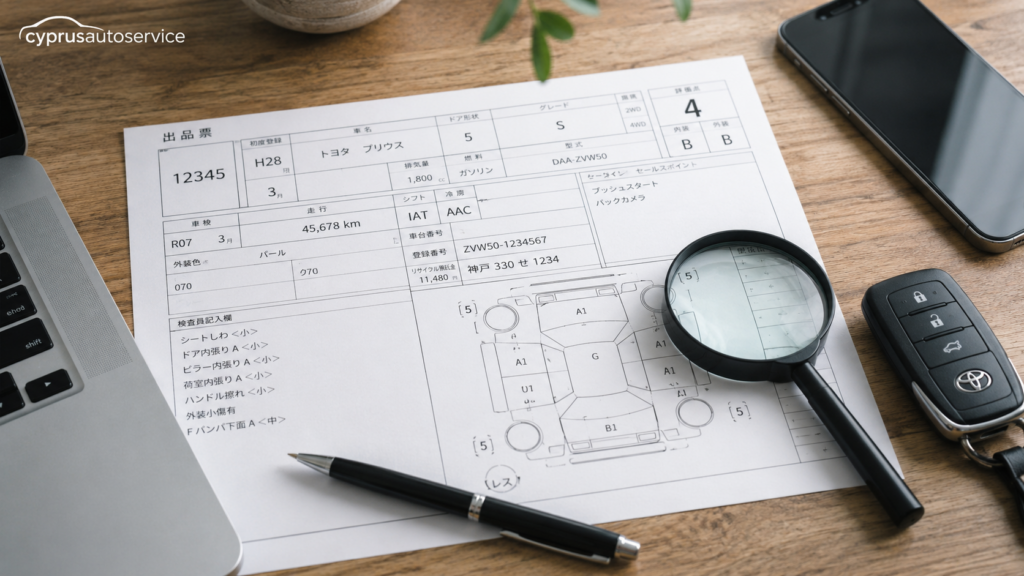
What Is a Japanese Auction Sheet?
A Japanese auction sheet is an official condition report prepared before a vehicle is sold through a Japanese car auction. It usually includes:
- auction grade
- mileage
- chassis number
- exterior condition
- interior condition
- repair history
- scratches, dents and paint marks
- corrosion or rust notes
- mechanical comments
- inspector remarks
- equipment and options
- car diagram with condition marks
This document is one of the main reasons Japanese car auctions are trusted worldwide. It gives buyers much more information than photos alone.
But there is an important detail.
The auction sheet must be understood correctly.
A car with a high grade is not automatically perfect. A car with a lower grade is not always bad. The real value is in reading the whole sheet, not just one number.
Why the Auction Grade Is Not Enough
Many buyers make the same mistake. They see grade 4 or 4.5 and immediately think the car is excellent.
Sometimes it is. Sometimes it is not.
Japanese auction grades are useful, but they are only a starting point.
A grade may show the general condition of the car, but it does not fully explain:
- where the damage is
- whether panels were replaced
- whether the car had paintwork
- if there are signs of corrosion
- if the interior has heavy wear
- if the mileage matches the condition
- whether the vehicle is suitable for Cyprus roads and climate
For example, a car can have a good overall grade but still have underbody corrosion. Another car may have a lower grade because of cosmetic scratches, but mechanically it can be a very good purchase.
This is why professional interpretation matters.

Common Japanese Auction Grades Explained
Here is a simple explanation of the most common grades:
Grade 5
Usually a very clean car, often newer, with very minor wear. These cars are normally expensive, but they can be excellent if the price still makes sense after shipping, taxes and registration.
Grade 4.5
A very good used vehicle. Usually clean, with minor marks or light wear. This is often one of the best grades for buyers who want quality without paying the price of an almost new car.
Grade 4
A good used car with normal signs of use. This can be a smart choice if the auction sheet is clean and the price is right.
Grade 3.5
Average used condition. This does not automatically mean bad. It means the car needs careful checking. Some grade 3.5 cars are good buys. Others are not worth the risk.
Grade 3
Often visible wear, damage, repairs or higher usage. It may still be acceptable for certain budgets, but it should never be bought blindly.
Grade R or RA
This usually indicates repair history. These cars must be checked very carefully. Some repaired cars are safe and properly fixed. Others may have structural damage or poor repair quality.
The problem is not the letter “R” itself. The problem is not knowing what was repaired, how serious it was and whether the car is still a safe purchase.
What the Car Diagram Tells You
The diagram on the auction sheet shows marks around the vehicle. These marks can indicate scratches, dents, paint waves, replaced panels, rust, corrosion or repaired areas.
Common symbols may include:
- A — scratch
- U — dent
- W — wave or paint repair
- S — rust
- C — corrosion
- X — part needs replacement
- XX — panel replaced
These marks are very important because they show where the issues are located.
A small scratch on a bumper is not a big problem. Corrosion near the underbody or structural area is much more serious. A replaced front panel may be acceptable in some cases, but it must be understood together with the inspector’s comments and repair history.
This is exactly where many buyers lose money. They look only at the photos and ignore the diagram.
Why Chassis Number Verification Matters
Before buying a Japanese car, the chassis number should be checked carefully.
The chassis number helps confirm the vehicle identity and allows you to compare the car against auction records, mileage history and available documents.
A proper chassis check can help detect:
- wrong vehicle information
- mileage inconsistencies
- fake or unclear auction sheets
- duplicated auction records
- previous sale history
- possible hidden accident history
If someone offers you a Japanese car but cannot provide a clear auction sheet or chassis details, this is a warning sign.
A serious seller should not be afraid of transparency.
Mileage: Why Low Mileage Is Not Always Enough
Many buyers love Japanese cars because they often come with low mileage. This is one of the big advantages of buying from Japan.
But low mileage should still be checked.
A car with low mileage but poor storage, corrosion, accident history or heavy interior wear may not be a good choice. At the same time, a car with slightly higher mileage but clean history and proper maintenance can be a much better purchase.
Mileage is important, but condition is more important.
The right question is not only “How many kilometres does it have?”
The right question is:
Does the full condition of the car match the mileage, price and future use in Cyprus?
The Biggest Mistakes Buyers in Cyprus Make
Many buyers in Cyprus make decisions based only on:
- nice photos
- low price
- low mileage
- general auction grade
- promises from the seller
- “it looks clean”
- “Japan cars are always good”
Japanese cars can be excellent. But not every car from Japan is a good car.
The biggest mistake is thinking that “from Japan” automatically means “safe to buy”.
A professional buyer checks the auction sheet, condition, price, shipping costs, taxes, registration, service needs and final value in Cyprus.
This is why we always recommend checking the full picture before paying a deposit.
Why Final Price Matters Before You Bid
A cheap auction price does not mean the car will be cheap in Cyprus.
Before buying, you should understand the full landed cost, including:
- car price in Japan
- auction fees
- inland transport in Japan
- shipping
- insurance
- port charges
- customs and taxes
- registration
- local preparation
- service or repairs if needed
This is one of the reasons we built a clearer way for clients to view Japanese auction and stock cars with final pricing logic through
A buyer should know the real budget before falling in love with a car.
A beautiful car at the wrong final price is not a good deal.
Why Local Support in Cyprus Is Important
Buying from Japan is not only about winning an auction.
The full process includes:
- choosing the right car
- checking the auction sheet
- confirming condition
- calculating the final price
- arranging export
- shipping to Cyprus
- customs process
- registration
- service and local preparation
This is where local support matters.
At Cyprus Auto Service, we are not just looking at the auction result. We think about the car as a future vehicle on Cyprus roads.
That means we care about:
- whether the car is suitable for the client
- whether the condition is honest
- whether the final price makes sense
- whether future service will be reasonable
- whether the client is protected from unnecessary risk
A good deal is not the cheapest car.
A good deal is the car that still makes sense after inspection, import, registration and real use.
When Should You Ask for Professional Auction Sheet Help?
You should ask for help before buying if:
- the auction sheet is in Japanese
- the car has grade R, RA, 3 or 3.5
- there are many marks on the diagram
- there are comments about corrosion or repairs
- the mileage looks unusually low
- the price looks too good
- the seller avoids clear answers
- you are not sure how to calculate the final cost
- you are buying the car remotely
The best time to check the car is before you pay.
Not after.
Once the car is bought, many problems become your problems.
Our Position: Transparency First
We believe the client should understand what they are buying.
Not just “nice car, good price”.
A proper purchase should be transparent:
- clear auction sheet
- clear condition explanation
- clear final price
- clear risks
- clear process
- clear support in Cyprus
This is the standard we want to bring to the car import market.
Because trust is not built by beautiful photos.
Trust is built by showing the truth before the client pays.
Need Help Checking a Japanese Auction Sheet?
If you already have an auction sheet and want to understand whether the car is worth buying, our team can help you read it correctly and explain the real condition in simple language.
If you are still searching for a vehicle, you can browse Japanese auction and stock options here:
Japanese auction and stock cars for Cyprus.
For local support, service, inspection and professional advice in Cyprus, visit here:
Before you pay for a car, check the story behind it.
Because the auction sheet is not just a document.
It is your first protection.
FAQ
Is a Japanese auction sheet always reliable?
A Japanese auction sheet is a very useful document, but it should still be read carefully. It is prepared by auction inspectors, and some comments can be short or subjective. This is why professional interpretation is important.
What does grade R mean on a Japanese auction sheet?
Grade R usually means the vehicle has repair history. It does not always mean the car is bad, but it must be checked carefully to understand what was repaired and whether the vehicle is safe and worth buying.
Can I buy a car from Japan without checking the auction sheet?
You can, but it is risky. Photos do not show everything. The auction sheet may reveal repairs, dents, scratches, corrosion, mileage notes or other details that are not visible in pictures.
Why should buyers in Cyprus check the final price before bidding?
Because the auction price is only one part of the total cost. Shipping, taxes, customs, registration and local preparation can significantly change the final price in Cyprus.
Where can I find Japanese cars for sale or auction in Cyprus?
You can view Japanese auction and stock cars through
BuyCarInCyprus.com.cy and get local support through Cyprus Auto Service